Joining Search and Rescue….
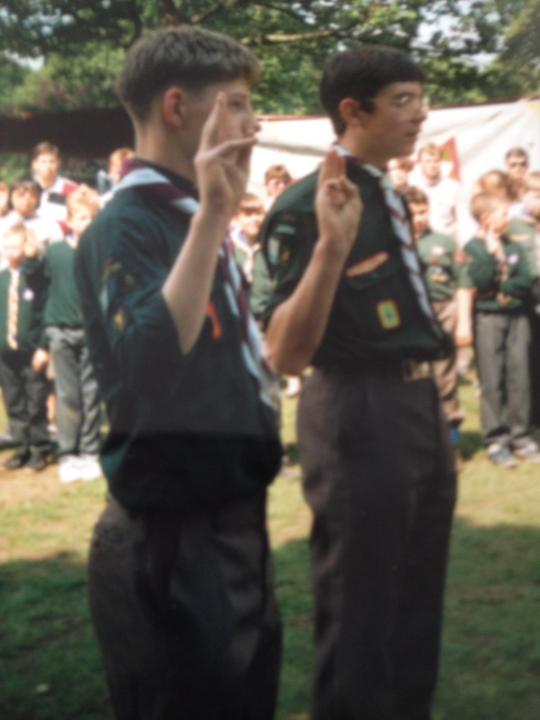
It was a couple of weeks later when the Search Team got back to me and if I wasn’t convinced before that it was meant to be, I was when I answered the phone. Bizarrely, the Membership Officer for the team on the other end of the telephone was an old Scout Leader of mine! I didn’t have much to do with Richard Archer in the scouts as our paths only crossed briefly, but I would now consider him one of my best friends in the team.
Applications to join were quite simple back then. I was asked to turn up to a training session on a Wednesday night and bring along some form of ID with me. I was excited when I turned up for my first session, having been asked to meet Richard at the gates of the military base where the team stored its equipment. A quick security check and I was back in my car following him across the base to the team’s hanger.
I was impressed when I arrived at the hanger. The team had two Land Rover defenders and a new Mercedes Sprinter parked up and Richard explained to me that the Sprinter had just recently been acquired via a lottery funded grant and was now fitted out as the teams control vehicle. It formed the control hub for each search deployment and was where the brains of the search operations planned and liaised with the Police. He explained that all the equipment I saw was funded by the public and that the team attended all sorts of events throughout the year to raise funds and would be expected to attend them.
The quick tour continued and I was shown all sorts of pieces of equipment – from stretchers to first aid kits to rope access equipment. I was introduced to the team members (about 30 in all) and then the evenings training started. The session that night was going to be on coping with death and recognising when someone was deceased. It was delivered by a doctor who was the teams go to advisor for clinical matters and he went through his slides on recognising signs of life extinct. It was, to say the least, a lesson to focus the mind. If I wasn’t sure about whether Search and Rescue was right for me, this would be the main reason why. It’s one of the main reasons we see people decide it’s not for them.
Those in the team recounted their own experiences of finding missing persons who were deceased and it was clear that one of the team’s main roles would be reuniting loved ones with their missing relatives. It was also clear that the type of work the Police asked the team to do means that many of the people who were missing were also despondent and that finding them dead was a likely outcome of many of the searches. It was something I hadn’t thought of before and it was a far cry from the work I had seen Mountain Rescue Teams carry out on the TV, when stranded walkers would call them asking for help. It would seem that most of the people I would be helping the team look for would either not want to be found, or would not know they were missing.
However, I wasn’t too concerned as I had already had my own experiences dealing with death, having investigated fatal accidents in my day job. I was quite familiar with pain and suffering that came with families losing loved ones as I had lost a friend to suicide a few years earlier so I knew how hard it was for friends and family. I began to feel that if I was able to be a part of something which could help make that more bearable, then this would make the whole experience worthwhile.
The training evening finished with a trip to the pub and a chance to chat with other team members about their experiences. I started to feel that I was going to be part of a group of fantastic people who selflessly gave up their time to satisfy their desire to do good and help their community. It was exactly what I wanted and it was also evident that the types of people that get involved in Search and Rescue were great to be around. I was accepted right from the first evening and it couldn’t have felt more right. I said my goodbyes and was told that the next sessions training would be on Cannock Chase.
The first practical session a week later was right in the middle of the Chase and saw us briefed on an exercise where a missing child had become separated from his parents and was last seen somewhere in the area. There was talk about the most likely area he would be found and how children act when lost. Statistics were referred to and we were all placed into small teams. My team’s leader explained how we should search and that the exercise would involve a search through the undergrowth surrounding the car park where we had arrived.
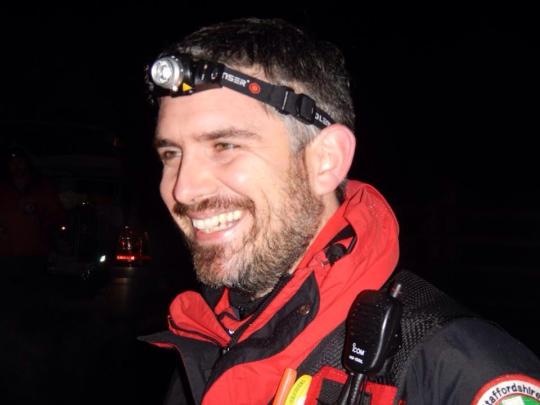 |
| Jim on a night time Exercise |
I soon realised that I was under-dressed. Apparently the most useful piece of equipment would be leg gaiters and whilst I owned some, I hadn’t got them with me. The error of my ways would soon be apparent and the result of my mistake would last until the following morning. Our team leader led us all through the undergrowth in the search for a small child sized dummy fondly referred to as “Billy.” A shout from my right some thirty minutes later as we walked through the undergrowth asked us all to “hold the line” and it saw me waiting patiently in a large crop of nettles while the team’s medic practiced on the dummy. The pain from the nettle stings and the excitement from the evening meant that I’d be awake half the night.
I attended training every week and looked forward to it immensely. It had given me a new lease of life and I was excited to be a part of the team. On my third week we were tasked to a local town in Staffordshire where we would be practising urban search techniques. We searched around the town and found ourselves in a field on the outskirts, where once again “hold the line” changed the team’s response to rescue as the search stage was complete. It was Billy again and I started to wonder why he was so careless becoming lost so quickly! This time he was propped up against a farm gate waiting for us to bring him back home where he would take his place on the hanger equipment shelves.
 |
Jim Receiving Member of the Year award (2016) |
The callout changed the atmosphere completely. Team members went from a relaxed jovial training mode to one of complete professionalism in an instant. Equipment was collected and packed away with efficiency, team members headed back to base to collect the other vehicles and everyone made way to a given location with me following behind. As we headed across the county in convoy the feeling was exhilarating. Whilst I was completely nervous at what I was going to experience it was utterly exciting being part of the response.
And then, just like that, it was over. Richard pulled his car over and asked me to stop. He got out of his car and came to mine and then explained that the team had been stood down. Operating an SMS call system, team members had received the message that the missing person had been found by the Police and they were no longer needed. It was a strange feeling but one I would encounter again and again over the coming years. I was hugely disappointed but at the same time filled with relief that the missing person had been found.
 |
| Map reading in SSART |
I attended the course and qualified in the November and my life in the search team became even more exciting. I would now spend the next few weeks staring at my phone wondering if it was still switched on waiting for a call out text message. Whilst my life was now so much more exciting, I wouldn’t realise until later that it still wasn’t quite complete. There was still something lacking.
The team mainly consisted of foot searchers and I began to attend callouts and make new friends in the team. There was talk amongst some of my colleagues about setting up a dog section within the team. Up until now the team hadn’t used dogs to search for people but there was an opportunity for them to start using them. This was exactly what I wanted to be involved in. It was perfect for me and there was no way I wasn’t going to get involved. I spoke with Dave Barley, who was planning on getting his own dog to train up and I told him I wanted to get involved.
To be continued…….